
Menu
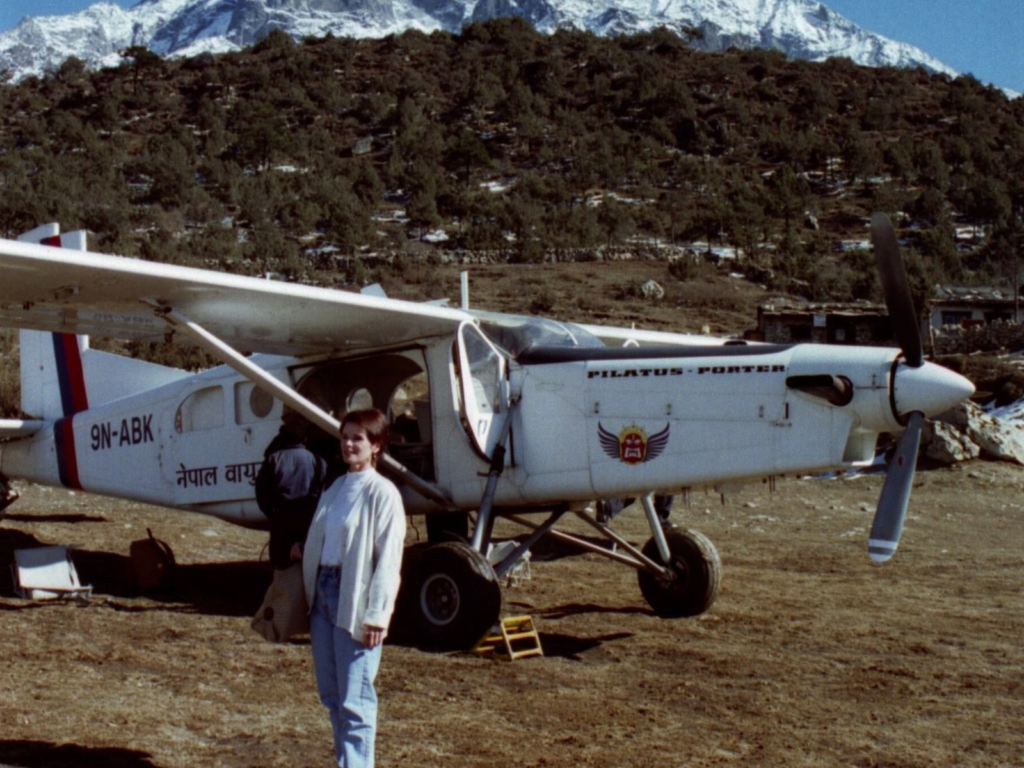
With only two weeks to see all of Nepal I was delighted when I discovered ‘a way to the top’ that would fit our schedule. The Hotel Everest View is located at 13,000 feet in full view of Mt. Everest, which is 29,028 feet. The peaks, Ama Dablam, Lhotse and Nupste, which are almost as high, are visible as well. Best of all, was a special hotel service; a plane that would fly us from Kathmandu to a tiny landing field with the exotic name of Shyangboche. The cost was high but with such savings in time and energy, I thought it would be worth it. Shyangboche is a one mile walk from the hotel; a trek I thought I could manage. The forty-five minute flight left Kathmandu at seven A M. We’d spend the night and fly back to Kathmandu the next morning. We were told that we’d need no more than a jacket, as by March the heavy winter weather would be past, and that the hotel had oxygen and medical assistance available. The last bit sobered and excited me, bringing home the reality of the height we were going to. It was common for the flight to be cancelled when the weather was too rough to land, and even if we could land, a cloud cover might block our view. Morning was the best chance, for by afternoon, the mountains were almost always shrouded again in their mysterious veils of white mist. Each day I prayed to the Nepali goddess Tara– fulfiller of wishes — that the weather would be clear for our single chance to see these wonders at close range. When the day of our flight arrived the rising sun turned the haze of Kathmandu Valley a soft rose hue. The smell of cooking fires mixed with gasoline, damp air, and cultivated fields of vegetables and rice into the sweet perfume unique to Asia. Sweeping us up into the traffic on the road to the airport, our guide drove wildly between bicycles and over-loaded carts of produce and assorted objects balanced precariously on shoulders, handlebars and seemingly any available surface. I peered anxiously out the dust covered window for clouds, but the visibility through the valley haze was no more than a couple of miles. At the airport an agent walked us out onto the field. A scraggly wire fence surrounded the field and landing strip. Beyond the fragile barrier tall dry grasses waved in the wind. The sweet scent of gasoline, blended with the roar and whine of engines and propellers. The plane that would take us, a Pilatus Porter, was designed specifically for short take off and landings, a necessity at Shangboche where we were going, nestled like an eagle’s aerie on a tiny plateau between the horns of jagged peaks.
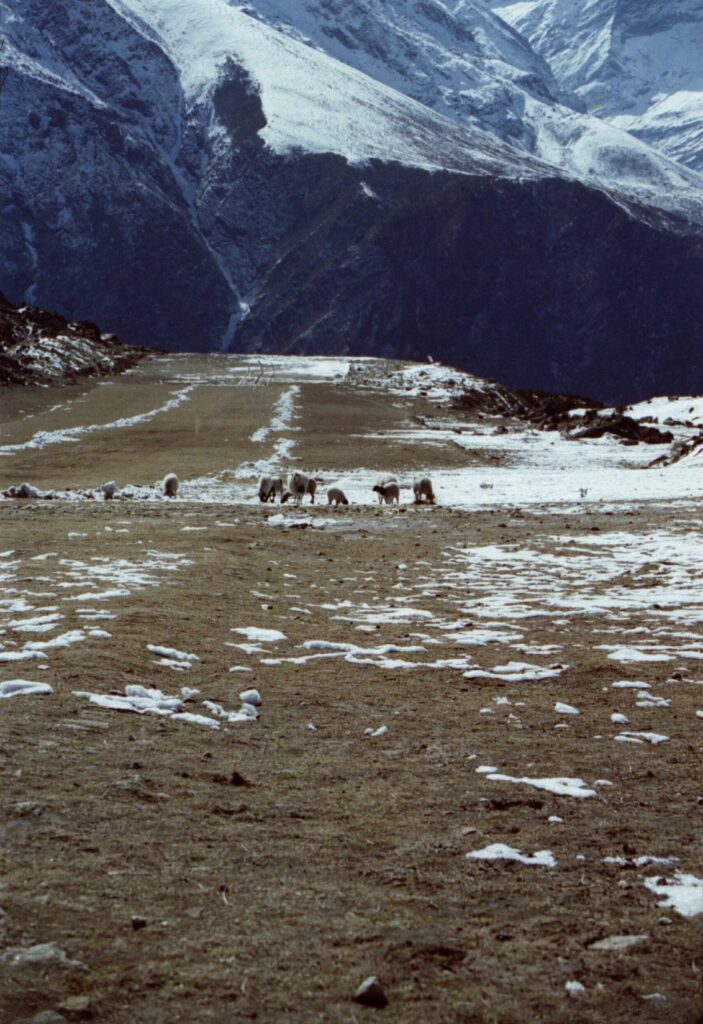
At last we were in the air and above the fog. Far below us the valley spread langorously in squares of cultivated fields of green, yellow, and brown dotted by red roofed buildings. To my left the range of mountains marched resolutely for as far as I could see ahead and behind. A line of attendant clouds billowed in loose formation above them, now closer, now further from their crowned heads. Located in the east part of Nepal bordering Tibet, Mt Everest is Sagarmatha to the Nepali (Mother of the Universe, or The Mountain So High that No Bird Can Fly Over It). For thousands of years the local people have worshipped the mountains. The source of rivers and weather that determine — not only the quality of their lives — but often life itself. For the Nepalize, the mountains are manifestations of the gods who unite the earth and sky and are guardians of the land, its people and animals. The pilot, Rajees, was a young Nepali man with shining black hair and aviator style sunglasses that made him appear older than he proved to be, and competent, which I hoped he was. He’d told me that he’d done this flight hundreds of times. I was grateful. Flying doesn’t usually frighten me, but the description of the tiny plateau we’d land on made me a bit anxious. I leaned close to him to be heard over the engine’s roar. “Where Is Everest?” He pointed down the cue of peaks, “Half an hour more, madam. Can’t see it yet.” “What do you think? Will it be clear?” He turned his head toward me and smiled, “Oh yes, Madam. It will be clear. You can depend on it.” I laughed to myself for my foolishness. I knew by now that the Nepali people always answer “yes” if asked a direct question. In preparation for the trip, I’d read guide books, mountaineering accounts and novels like Peter Matthieson’s, THE SNOW LEOPARD. (There are literally thousands of books written about this tiny kingdom, testifying to its universal appeal.) Without exception, the writers spoke of the unique blend of cultures and religions that made up what we now call Nepali People; a misnomer as Nepal has over fifty tribes and a mixture of Hinduism, Buddhism, Tantrism and animistic rites and shamanic practices. Of the people I’d met, the very diversity of their environment seemed to be their common bond, and their exceptional tolerance rose out of that rich soil. Soon we banked left and headed directly toward the mountains. As we approached, I leaned forward in my seat. Below us the ground rose up with row upon row of stepped slopes carved into the hills like waves rushing down from the heights to the valley far below. Slowly the peaks became more distinct as we rushed toward them, until they filled my vision and left only a small area of sky above our heads. When it looked like we’d crash into a wall of rock and snow, a way between suddenly opened, and we were inside the first line moving in a world of sheer cliffs I could almost reach out and touch. Our plane was as small as a bird winging it’s way among silent giants their arms enfolding us and their heads towering above. No wonder people spoke of this place as being ‘of the gods’. These mountains were truly godly in their size and power, and they did indeed seem to be silently watching us. Rajees pointed ahead to the right. “There is the field. See it?” I nodded, mute with wonder and excitement. A narrow flat space lay between snow covered cliffs. As we approached, I could make out a couple of buildings, people and sheep. Then, so quickly I didn’t have time to notice any fear, we were on the ground. When we climbed out, a woman introduced herself as an agent from the hotel. She instructed us to please sit on the bench and rest for half an hour before ascending to the hotel. “You have come up quickly to a great height. Altitude sickness is possible even for people who trek ten days to get here. Would you like some tea?” We accepted happily and sat obediently on the bench that rested against a stone building. With the excitement of getting here over, I looked around at the scene I’d prayed to see. There wasn’t a cloud in the sky, and the sun was more intense than I’d
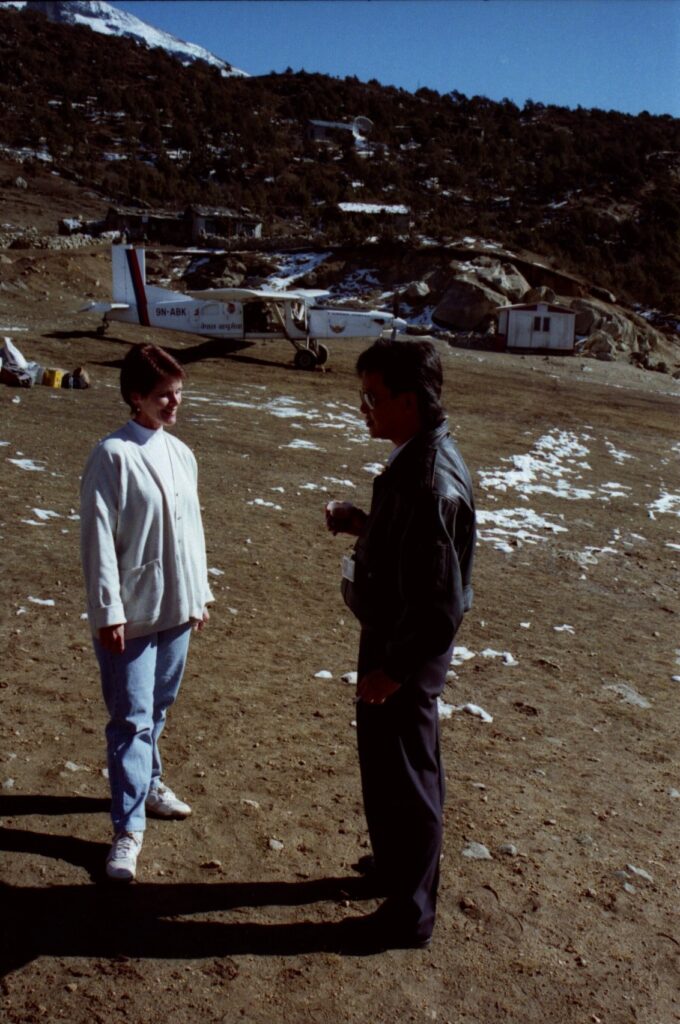
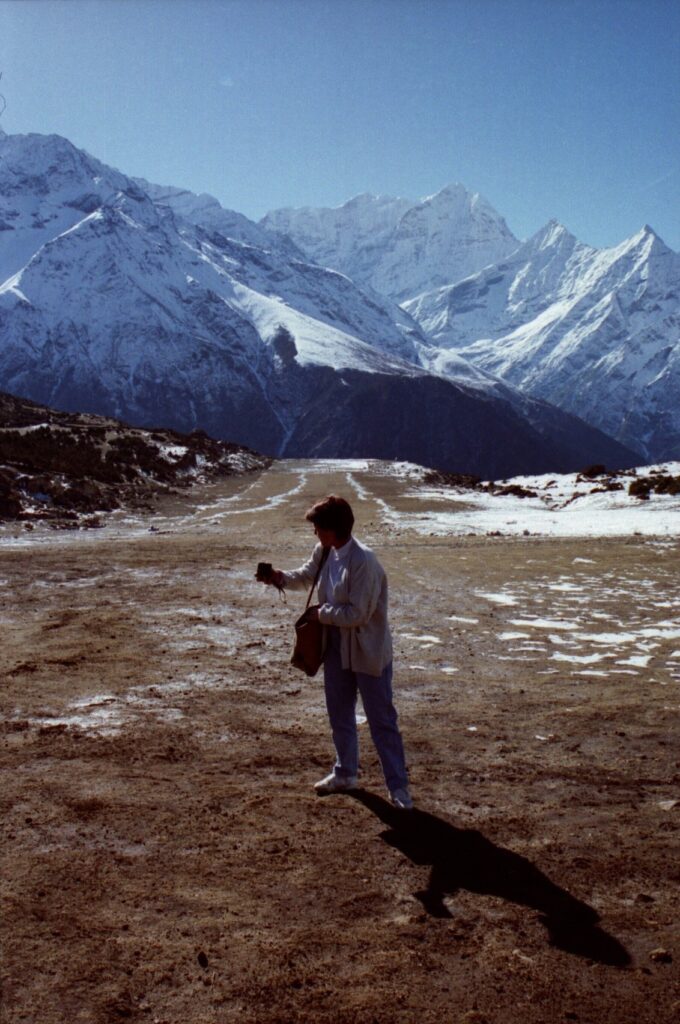
ever felt before. The air was so crear my vision seemed sharper; the edges of objects were sharp and certain, the smells bright. The mountains formed a circle around us; snow covered masses of rock, jagged and majestic. Within reach, they were yet unreachable in some mysterious other-wordly quality, not unlike the moon. Together with the dense silence, I was slightly giddy. Once on the trail we meandered up the gentle incline from the landing field over hills with few trees and some occasional scrubby brush. Patches of snow appeared occasionally beside the trail, but most of it was above us. At each bend in the path I craned for a view of the peaks I knew would appear at any moment. Thirty minutes into the climb it happened. Like a monolith rising from a sea of brown dirt rose a pinnacle of white; a giant out of storybooks I’d read as a child. Ama Dablam, the most beautiful of the mountains of the world. Smack in front of us. We were stopped, gaping and wide-eyed as children. Soon the whole range was before us; Everest, Ama Dablam, Lhotse, Nuptse, Kwangde, Kantega, clustered together like tall friends who survey the world from a vantage so high that all that lies below them is small and helpless in comparison. Guardians they are, I thought remembering the many myths and legends the people of this region tell about them. No wonder so much of their life and customs take the mountains into consideration, giving them homage and praying for their care and protection. My breath was short when we came to the hotel. Set on a small rise, built of rock and wood, it was as gracious as the world around us. Wide steps led up to huge wood doors and an expansive entry with high ceilings. Straight ahead, floor to ceiling glass windows ran the forty foot length of the wall to frame the entire range of mountains. “Now this is a picture window,” I said to our guide laughing. The hotel was designed around the spectacle so that the public rooms and all 12 private rooms have similar ‘window walls’ and are situated to face the view. Outside the entry area was a long wide deck with benches and tables. I headed straight to it, anxious for a closer look. A waiter poured tea for three people who sat at one of the long tables with their large backpacks leaned against the low stone rail at the edge of the deck. We were in the Solu Kumbu region, a popular trekking destination as much for its monasteries and Sherpa villages as for the mountains. The waiter smiled and greeted us with the local ‘hello’ which in Nepali is; Namaste (I salute the god within you) He came over to point out the names of the peaks. ‘Below us on that high rise surrounded by firs and rhododendrons is Tengpoche Monastery, the Buddhist center for the whole region,’ he told us. Its many and varied high peaked roofs glistened in the sunlight. Pointing left, he continued. “There, that is Khumjung, the biggest village in the Kumbu. Sir Edmund Hillary, you know Sir Hilary?” We nodded. “The first to climb Everest in 1953. He built a school to educate our children. All children of the Kumbu may attend. Before he built it, the nearest school was two days away.” He smiled broadly. “You are hungry? You will have breakfast?” We agreed and thanked him for helping us. After ordering breakfast we chatted with the trekkers who told us about their adventurous two week walk to reach this spot; stories of village life among people whose lives were lived in the harshness of the heights. The trekkers were also from the United States and would be continuing on to the Everest Base Camp another seven days ahead, and 4800 feet higher. I envied them the time they had to immerse themselves in the culture of the most unusual Sherpa people. But I didn’t covet the difficulty of the high altitude they were going to. I was beginning to experience the first signs of our quick ascent; headache and drowsiness. Soon we went to our room for a rest. it was spacious, with a private deck, and bath, though water had to be brought in by hand as the pipes had broken last week and no one knew how long it would be before they were repaired. Away from the direct heat of the sun, everywhere inside the building was cold. There was a small space heater in our room that did little to take the chill off the high-ceilinged room. Late in the day, we decided to take a walk before dinner. We headed toward the hills that wandered off to the right of the hotel where we discovered deer trails that zigzagged between rhododendron and fir trees. The sound of our feet crunching pine needles and small rocks intruded into the deep silence. Clouds had begun to form around the peaks. Wind blew the mist around like white curtains that covered and then revealed the mountains. As the sun broke through the clouds the whole environment was a play of light and shadow in continual change. It was also thickening and slowly moving toward us. I knew we’d soon lose sight of the mountains for the day. When the mist had swept over us, the most unusual thing happened. I could see each particle of water in the air as the light bounced off of it. The air was thick with literally millions of tiny lights that seemed to dance around us. I rubbed my eyes in disbelief but the dance continued. I wondered if the altitude was causing me to imagine things, but my friend was having the same experience. Mesmerized, we sat down on the damp grass and gave in to the enchantment. Back at the hotel, contrary to what we’d been told about the weather, the temperature had dropped considerably. We didn’t have warm clothes with us. Beside the front desk was a small kiosk shop of products made by the Khumjung village people. We found hats, mittens, and socks made from yak fur (a hugh high mountain animal with fur that hangs to the ground, rather like a cross between a Brahma bull, a cow, and a mountain goat). The lives of the mountain people are dependent entirely on these docile hard working animals. Our beautiful new clothes were made by hand by the residents of Khumjung. They were very thick and cream colored with a dark brown band of design woven in. We wrapped ourselves in them gratefully, and in the sweet scent of lanolin and animal that came from them. Together with the jackets the hotel manager had loaned us, we felt more ready for whatever the weather was going to bring. By dinner time my head was throbbing. I took a couple of aspirin and went to eat with the hope that food would help me acclimatize. In the dining room huge ancient black stones were incorporated into the building. Inscribed across them in bold letters, was, “Om Mani Padme Hum.” A reminder of the deep religious sentiments of the local people to their land. Seated at the table beside us was a Japanese family; parents, grandparents and three children from five to ten years old. There were no other guests. We’d heard that the hotel prided itself on its gourmet food, which turned out to be no idle boast. A delicate, perfectly seasoned asparagus soup was followed by veal cooked to perfection with tiny roast potatoes. Dessert was a fine flaky apple turnover. When we’d finished, we sat beside the only heat in the room; a big round brazier with a few small charcoals burning inside, but with enough heat to take the chill off my hands. The aroma was dank and comforting. The Japanese family had also come to the heat. While we attempted to get warm we tried to talk to each other, neither knowing the other’s language. it was good fun with plenty of laughter at our clumsiness and at our efforts to connect. The manager of the hotel, a young man from Khatmandu, came to tell us that the staff was going to put on a show of local dance and song for our after-dinner entertainment. There were a dozen men ranging in age from around fifteen to sixty years old. They all lived in nearby villages and were Sherpa. The Sherpa ar the most famous, though one of the smallest in number, of the many Nepali tribes. They’ve gained fame for their great strength and endurance from living at high altitudes in inhospitable regions. These attributes have made them valued guides for trekkers and mountaineers. They were also warm, generous and fun loving. The group of men formed a semi-circle facing us and began to sing and clap. One after another of them stepped into the circle and did a particular dance. Watching them perform I was reminded of what we’d been told earlier in the day about the festival held at the monastery of Temgpoche to celebrate Buddhism’s triumph over Bon, the ancient animistic religion of Tibet. People from the region come every year in December to dance and sing for many days. By the time they’d finished, my head felt like it was getting ready to explode, and I had the odd sensation of falling asleep on my feet. I could hardly keep my eyes opened. Alarmed, my friend put me to bed, and went to speak with the manager who came back with an oxygen tank and mask. By then I was slightly incoherent and only remember being instructed on how to breath, and the huge relief as the pain in my head subsided, and I fell into a heavy sleep. I dreamed wild hallucinatory dreams that made no sense on waking, but left me with a deeper feeling of this exotic place. I’d heard that people often have unusual dreams at high altitudes, sometimes dreams that change their lives. Edmund Hilary wrote about the effect of altitude on his dreams, dreams that would eventually make Nepal his home. Other mountaineers stressed the hallucinatory effect of the thin air and the difficulty of knowing real from imaginary at such heights. This crossover of inner and outer realities has often led people to their deaths as their ability to think clearly was diminished and their judgment became unsound. In May of 1996, five climbers died near the top of Mt. Everest. Two of the five had been to the top before so were not inexperienced. Their tragic deaths were one more in a series of misadventures on Everest. Some people say that their deaths were caused by a rogue storm, while others postulate the effects of thin air on judgment. We will never know. In an effort to keep warm the night before, we’d closed our curtains. I got up to open them to discover a completely white world. Several inches of snow had fallen in the night and the morning sun shimmered brilliantly over all. It appeared to me like a fairyland — fairy reminding me of fey — meaning, untrustworthy, dangerous and wonderful. After breakfast we said goodby to the staff who’d been so gracious and warm in our short stay. I was both sad and glad. Though I longed to see more and know the people who lived here, my body wasn’t able to manage the strain. However, to have known this place for even one day was worth that strain, and I would forever be grateful to have been touched by its ‘fey’ nature.